Archive for People
May 23, 2008 at 1:50 pm · Filed under The Habit Code, Napoleon Hill, Andrew Carnegie
Having read all of Napoleon Hill’s books, his magazines and other peoples ideas on the Principles Of Success within Think and Grow Rich, I’ve finally come to a conclusion of what Hill is was so eloquently saying.
There are two major principles within Think And Grow Rich that stand out far and above anything else mentioned.
In fact, if you read between the lines, and sometimes between the books (i.e. read some of Hill’s earlier and later works) Hill leaves some clues to what the Key parts of his philosopy are.
Now, Hill states that it is better if you discover the secret yourself, and I believe that to be true. I’ve seen so many different answers to the Carniegie secret that what’s important is that you try to find it for yourself. You get such an emotional boost when you discover it for yourself that it can be the motivator to change your life from that moment on.
If on the other hand you’ve read Think and Grow Rich several times and still seem to miss the point then continue to the end of this post.
Before you do though, think about this. Even though Napoleon Hill interviewed 500 of the worlds richest people, and also thousands of others who were not rich, it took him many years to distill down the formula of what it is that makes someone a success. He also DID NOT practice what he preached. He did leave a few clues about the REAL motivating factors that cause people to succeed.
He left some clues to it in his many books. What bugs me is that he didn’t bring these to the attention of people. Sorry, I should state that He DID bring these to people’s attention, but they were only passing references to the one true thing that I feel allows people to become successful, and to why only a tiny percent of people ever discover it.
Now if you want my explanation of Napoleon Hill’s ‘Secret’ Then Read the following post.
http://www.thehabitcode.com/2008/05/16/the-carnegie-secret/
May 16, 2008 at 3:04 pm · Filed under The Habit Code, Napoleon Hill, Andrew Carnegie
Ok, So you are here to discover the Andrew Carnegie Secret the Famous Industrialist Andrew Carnegie told to Napoleon Hill in their Interview at Carnegie’s house in 1908. If NOT I suggest you CLOSE THIS PAGE IMMEDIATELY.
Napoleon Hill States that it is better to discover the secret for yourself. If you have read the book a few times and still can’t find the answers then read on!
Note that this is only my personal interpretation, but it is based on a four year study of Napoleon Hill’s writings.
Napoleon Hill was a young newspaper reporter, sent on an assignment to interview Andrew Carnegie, who was the richest person in the world at the time.
Although those that know what was actually said in the interview are no longer with us, from reading Napoleon Hill’s Work you get some of the clues to the philosophy, and to what parts are the keystones to the whole philosophy.
Here are just some of the clues.
1: In Think and Grow Rich - “The Master Mind principle, or rather the economic feature of it, was first called to my attention by Andrew Carnegie, over twenty-five years ago. Discovery of this principle was responsible for the choice of my life’s work.“
2: Throughout Think And Grow Rich - The stories that Hill uses contain obvious use of The Master Mind Principle.
* Andrew Carnegie and his staff of 50 men. Experts in their own field.
* Napoleon Hill and his Son learning to hear again. (remember a mastermind can be achieved with just 2 minds)
* The Signing Of The Declaration Of Independence.
* Henry Ford and his masterly use of a master mind to supply him specialized knowledge.
* The formation of United States Steel Corporation by Charles M. Schwab.
* The Story Of Gandhi.
* Napoleon Hill’s Imaginary Master Mind in the chapter on the sixth sense.
——
“Analyze the record of any man who has accumulated a great fortune, and many of those who have accumulated modest fortunes, and you will find that they have either consciously, or unconsciously, employed the ‘master mind’ principle.”
——
3. In Law Of Success - “In This introduction you will find a description of a newly discovered law of psychology that is the very foundation stone of all outstanding personal acheivements. I refer to this as the Master Mind”
——
” Many a man who never knows the real source of his success, is made by his wife, through application of the Master Mind.”
——
“It is believed by many scientists…that the law of the master mind is the basis of practically all of the more important achievements resulting from group or cooperative effort”
——
“Nearly twenty years ago I interviewed Mr. Carnegie for the purpose of writing a story about him. During the interview I asked him to what he attributed his success. With a merry little twinkle in his eyes he said:
“Young man, before I answer your question will you please define your term ’success’?”
After waiting until he saw that I was somewhat embarrassed by his request he continued:
“By success you have reference to my money, have you not?”
I assured him that money was the term by which most people measured success, and he then said:
“Oh, well - if you wish to know how I got my money - if that is what you call success - I will answer your question by saying that we have a master mind here in our business, and that mind is made up of more than a score of men who constitute my personal staff of superintendents and managers and accountants and chemists and other necessary types.
No one person in this group is the master mind of which I speak, but the sum total of the minds in the group, co-ordinated, organized and directed to a definite end in a spirit of harmonious co-operation is the power that got my money for me. No two minds in the group are exactly alike, but each man in the group does the thing that he is supposed to do and he does it better than any other person in the world could do it.”
Then and there the seed out of which this course has been developed was sown in my mind, but that seed did not take root or germinate until later. This interview marked the beginning of years of research which led, finally, to the discovery of the principle of psychology described in the Introductory Lesson as the Master Mind.
I heard all that Mr. Carnegie said, but it took the knowledge gained from many years of subsequent contact with the business world to enable me to assimilate that which he said and clearly grasp and understand the principle back of it, which was nothing more nor less than the principle of organized effort upon which this course on the Law of Success is founded.
Carnegie’s group of men constituted a Master Mind and that mind was so well organized, so well co-ordinated, so powerful, that it could have accumulated millions of dollars for Mr. Carnegie in practically any sort of endeavor of a commercial or industrial nature. The steel business in which that mind was engaged was but an incident in connection with the accumulation of the Carnegie wealth.
The same wealth could have been accumulated had the Master Mind been directed in the coal business or the banking business or the grocery business, for the reason that back of the mind was power - that sort of power which you may have when you shall have organized the faculties of your own mind and allied yourself with other well organized minds for the attainment of a definite chief aim in life.”
——
Within Think and Grow Rich, Napoleon Hill states that there are TWO parts to the secret. Well, my understanding on that is that you must have a Definite Cheif Aim. This DOES NOT need to be your final life’s goal. It just needs to be a normal goal. The big secret is that you must get emotionally attached to it.
“Big Deal” - I hear you say.
This is where I think most people fall down on the whole Think and Grow Rich formula. You must get emotional about your goal.
Now, I’m not talking about getting a bit excited. I’m not talking about urging, or wishing, shouting, screaming or even jumping up and down emotional. I mean you have to get emotional “as if someone had tied a concrete ball around your neck and thrown you into the Fishermans Wharf” emotional.
On a scale of 1 - 10 (10 being drowning) The closer you are to a 10 the better. It depends on your DESIRE. How much you want something. A 1 is when your just wishing for something, because it might be nice to have. A 10 is when your life depends on it.
When you think about it…when you really think about the Secret in Think and Grow Rich, it is all about your subconscious. Well , not just yours, but the subconscious of your Master Mind group too.
The reason you need to get emotional is this - ONLY Emotionalized thoughts have any ACTION influence upon the subconscious mind. The more Emotion you can mix with a thought, the more your subconscious will take action on that thought.
This can be achieved SLOWLY using the principle of AUTOSUGGESTION Or it can happen quickly such as when having a breakdown, crisis, accident or even when being super emotionally charged.
A Perfect Example
For an example that shows the secret in all it’s glory I refer back to a story that Napoleon Hill tells in Law Of Success. It starts with Napoleon Hill making a trip to Lumberport, West Virginia. At the time of his visit the interurban electric train line did not make it all the way to Lumberport, but stopped three miles away. The remainder of the distance had to be covered by foot. Unfortunately that afternoon the rains came down and Napoleon Hill had a dreadful long trudge through deep yellow mud, to get to his destination.
Now imagine if you will the emotion and the state of mind as Nap Hill dragged himself three miles through the pouring rain, and mud.
Do you think he was emotionally charged?
Absolutely! With anger, admittedly, but he was probably boiling up this emotion for an hour or more.
When he eventually reaches the town of Lumberport, sodden, muddy and exhausted, he bumps into the cashier of the Lumberport Bank and strikes up a conversation as to why the line has not been built
To cut a long story short Napoleon Hill gets so het up about the fact that the trolley line does not come all the way into the town of Lumberport that he finds out the reasons why there is no line into town. He then sets his Definite Major Purpose there and then - To get the streetcar line built. This would be no mean task - because the cost of building the line and bridge was un-economical. Or so it seemed.
Now, did Napoleon Hill go to his hotel and use Autosuggestion to get his subconscious mind working. NO!. (His subconscious was already on the case because he was EMOTIONAL about the cause) He made plans there and then and within 24 hours had got together a MASTER MIND of the towns People, The Mayor, The Divisional Superintendent of The Baltimore & Ohio Railroad Company. After meetings with all concerned he Convinced the three main parties involved that it was in their interests to get the line built (again USING The MASTER MIND Principle). Within 3 weeks the contracts were signed. Within Two Months construction had begun, and three months after that, the first streetcars were running into Lumberport! Amazing.
So, in conlusion the major parts of the Carnegie Secret are as follows:
1. Convincing YOUR Subconcious Mind Of a Goal or Definite Chief Aim.
2. Convincing The Subconscious Mind of your MASTER MIND group to accomplish your goal.
ALL Other parts of the philosophy are to reinforce these two ideas and act as a feedback system.
January 15, 2008 at 6:04 pm · Filed under The Habit Code, Carl Jung
If you go back quite a few posts you will see an entry about The Collective Unconscious. I’ll just add to that post and try to elaborate on it somewhat.
As Carl Jung stated the Collective Unconscious is the “reservoir of the experiences of our species“.
I personally take that to mean that an amount of the experiences that YOU have during your lifetime (whether that’s Memories, Emotions or Imaginative thoughts) CAN be passed from generation to generation. If an experience generates ENOUGH emotion within you then this can form a connection in the brain that is passed on through our genes so that the next generation can benefit from the experience.
When all’s said and done we are Animals. Maybe we are fairly advanced for our species ( maybe not a good thing all the time ). But we have evolved with Instincts. Instincts are inbuilt within the brains of humans from conception. They have to be transferred by some genetic method. Instincts have evolved by the necessity of life to re-generate. Passing on useful information from one generation to the next allows the next generation to be slightly different and this genetic mutation allows life to proliferate.
All the Instincts we have are governed by our SUBCONSCIOUS mind, we have no knowledge of them, until the Instinct is triggered by some emotional need. i.e. Sex, Hunger, Protection.
Now as well as Instincts that cover our basic human needs what if actual thoughts could be passed from generation to generation. Unfortunately, you cannot consciously remember these thoughts. They are stored within your Collective Unconscious. I am not saying that ALL your thoughts can be transfered to the Collective Unconsciousness of your offspring. What I am saying is that IF thoughts are mixed with a tremendous amount of emotion then these will burn a deep indelible path in your synapses and with this depth of conscious recording, a shadow, an emotion or maybe even the actual thought, is passed through your genes to your offspring’s Collective Unconscious.
Maybe it is just one dominating thought or experience that is passed from generation to generation, but when an external trigger fires this unconscious thought, it will influence you to make a decision one way or the other. Wouldn’t this be a good explanation of ‘The Sixth Sense’ that Napoleon Hill wrote about in Think And Grow Rich. In fact it might explain quite a few human experiences that we get such as déjà vu, telepathy, Regretion and Dreams.
If it happened that one Emotionalized Memory (EM’s) was passed down between generations then we would receive one from each of our parents. Our parents would have received two each from their parents and… so on… and so on…
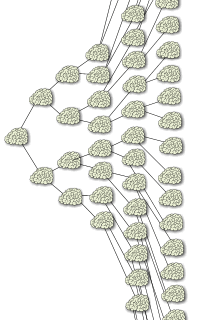
…Now in the post on the collective conscious I said that if you go back just three generations then you will have received 14 EM remnants. Ok, I hope your still with me here, If we go back just 64 generations ( that would take us back to the first century A.D. if we believe a generation to be 30 years for arguments sake ) then how many EM’s would you expect to be passed down to you.
I’m sure the answer will surprise you. It sure did me.
The answer is 18,446,744,073,709,551,614
which works out at Eighteen Quintillion, Four Hundred Forty Six Quadrillion, Seven Hundred Forty Four Trillion, Seventy Three Billion, Seven Hundred Nine Million, Five Hundred Fifty One Thousand, Six hundred and fourteen.
No wonder there are so many shrinks in the world.
January 15, 2008 at 3:08 pm · Filed under The Habit Code, Napoleon Hill

You know the feeling, I’m sure…
…when you start a conversation with someone, and then deep down, something inside you just clicks. Without a word being uttered the person you’re talking too feels it too. A strange Primeval “deep in the soul” kind of feeling when your mind ‘connects’ with another person’s.
They somehow know what you’re about to say. Your thought paths converge. You’re both completely absorbed in the conversation. A feeling of confidence washes over you and time no longer exists. In this absorbed state of mind hours will pass you by as quickly as they ever have. I suppose for want of a better term, you could call it Empathic Hypnosis, as you are both taken into a trance like state.
This “Empathic Hypnosis” is what is behind the power of Napoleon Hill’s Master Mind Theory. Producing this ‘connection’ between two people is hard enough, but when you add in more minds to form a group of three or more, the fine balancing act between the minds in the group gets harder, logarithmically it seems.
Let’s first get back to this Empathic Hypnosis theory and try and work out what it actually is.
I’ll explain that in the next update soon.
December 3, 2007 at 7:00 pm · Filed under The Habit Code, Carl Jung
I talked about Carl Jung the other day and about the Collective Unconscious. I may have made a slight mistake in estimating the number of generations. Lets take a quick look at the maths again.
“A reservoir of the experiences of our species” is how Carl Jung explains the Collective Unconscious. I’m trying to make sense of this and have come up with this theory. Your parents pass down to you the color of your eyes and other genetic make up. They also pass down instinctual thought processes that are essential for you to take your first breath and to root for food. Also the emotions are passed down to you and these are brought out in the first few weeks of life. How instincts are passed down I do not know but are they not in essence memory programming from your parents.
If Instincts and Emotions can be passed down through the process of Life then why not imbedded memories. Can deep rooted memories from your parents be programmed into your subconscious.
Think about it, deja vu, the Sixth Sense and all other weird spiritual phenomena could be attributed to these deep rooted subconscious memories.
These Deep Rooted subconscious memories are blocked from the conscious but can be visualised in dreams, hypnosis and other ways of connecting with the subconscious.
I’ve gone off subject here. The other day I said that if ONE instinct, or Memory could be transfered from your parents all the way down your lineage (I’m talking all the way back to worms and amoebas) then there could be something in the region of 116 million subconscious thoughts or Programmes. I made a bit of a booboo though, I forgot that each generation is created by TWO parents.
In the diagram here, if we have THREE generations then we have the Collective Unconscious of 14 predecessors. This could get interesting. I’ll come back to this and let you think about the collective unconscious if we go back 3.7 Billion Years.
November 27, 2007 at 4:32 pm · Filed under The Habit Code, Good Habits, Matthieu Ricard
Habits Of Happiness. Matthieu Ricard, Budhist Monk, Photographer and Author. Some people say he’s the happiest man on the planet. Happiness is a state of mind and so the theory is that if you can control the mind through meditation and concentration bad thoughts just pass through your concious ‘like a bird through the sky’. You do not dwell on them and they are only fleeting.
Good thoughts and Bad Thoughts can not be in the conscious mind at the same time, so I suppose meditation would be helpful.
See the video of Matthieu at the TED conference (Technology, Entertainment, Design) below
Ted.com’s Matthieu Ricard Talk
November 26, 2007 at 5:24 pm · Filed under The Habit Code, What Are Habits, Napoleon Hill
Cosmic Habitforce. What is it really?
Napoleon Hill describes it so:
“Cosmic Habitforce is the greatest of all natural laws. It is Nature’s comptroller through which all other natural laws are coordinated.”
However you think the universe was created, you cannot deny the underlying march of time and the precise way that all things within the universe seem connected. The creation of stars, galaxies, planets and ultimately life seems to be on automatic pilot. Whether you believe in a God or not you cannot deny the sheer beauty of the way the laws of nature work and how they all seem to mesh perfectly, stopping for nobody.
Nothing is needed to keep the universe on it’s course, it does so without a care, as if it was a clock so perfectly ballanced, that it needed the mere first winding to set it on it’s way.
As nature set it’s physical laws it also set it’s biological ones, the absolute continuation of life and how it evolves to match any change in it’s surroundings, again, automatically, and without any external help. Habit is a neccessity of life, and habitation seems to be a mechanism where the changes in an environment for a species causes a habit to form. This habit formation causes brain patterns to be hard wired, and this in turn causes habits to become heredetery. The passing of one habit to the next generation can help the next generation to survive, it allows for changes in evolution.
Cosmic Habitforce is the law that fixes habits. It is the conductor that keeps the universe in time but changing all the time, making sure that everything evolves, that night follows day, that oaks will come of acorns, that life will evolve and thrive to it’s natural environment.
November 26, 2007 at 4:28 pm · Filed under The Habit Code, Carl Jung
My interpretation of the Collective Unconscious is as follows:
Carl Jung stated the collective unconscious as the following,
“…a reservoir of the experiences of our species…”
…this quote sent a shiver down my spine because it echoes my feelings on what I believe. It is the unconscious feelings, thoughts and experiences not just of our species, but of every living thing on the planet.
It is all of those things that are passed down from generation to generation. It is the memories and habits passed from the very first cell like structures to sea fearing creatures, the first land animals. On through the early mammals and finally to homo sapiens. If we believe that microbes first made a mark on the earth some 3.5 billion years ago and we take for arguments sake the generation period of humans as 30 years (from birth to birth) then we get over 116 million generations of life (remember, that is using 30 year generation interval).
If we say that just ONE experience, thought, memory or instinct is passed on by every generation to the next and stored in the collective unconsciousness that is at least 116 million subdued thoughts that cannot be easily brought into the conscious.
November 19, 2007 at 11:05 pm · Filed under The Habit Code, People, Carl Jung
It looks like I boobed on the description I have for psyche. In fact several times different people have called The Body, Mind Soul concept differently. It’s all part of the discovery of psychology I feel.
Doing some more research brought up Dr Carl Jung and his thoughts on the psychology of human beings. This brilliant post appeared that gives a good description of what Jung stated. I will have to read some of Jung’s work, but this post does gel with my way of thinking and says that Carl Jung thought that the human ‘Mind’ was made of three parts.
- The Conscious part of the mind which is the part of your mind that is aware and sentient.
- The Personal Unconscious - which is all of your stored memories. You can recall these into your conscious but reside in the unconscious.
- The Collective Unconscious - which is the reservoir of the experiences of our species.
That last point is one to look at. For it agrees with what I feel. It is the small part of knowledge that is past down from generation to generation, from the very beginings of life and is part of evolution.
You can find the post here The Collective Unconscious
You can also read about the collective unconscious and further info on Jung at wikipedia
November 7, 2007 at 11:20 pm · Filed under The Habit Code, Napoleon Hill
This last week I waited paitiently for the postman to arrive, The delivery - Napoleon Hill’s First Editions - ordered from Amazon was now 5 days overdue. I had ordered the book as it contained some reprints of Napoleon Hill’s writings from his two magazines “Hill’s Golden Rule” and “Napoleon Hill’s Magazine”. I was hoping to learn some more information to fill The Habit Code’s philosophy.
Here then is a review of the book:
The book contains 236 pages and is a collection of articles first published in Hill’s Golden Rule Magazine (Published between February 1919 and September 1920) and Napoleon Hill’s Magazine (Published between April 1921 and September 1923) with one other article from ‘Science Of Success Homestudy Training Course’ written with W Clement Stone.
Foreword By Don M Green - Don M Green explains a little background information on Napoleon Hill’s life and of what he accomplished.
Chapter 1. What You Need To Know. The book was compiled and edited by Michael J Ritt Jr. a co worker of Napoleon Hill’s during his years with W Clement Stone and the author of Hill’s Biography ‘A Lifetime of Riches: The Biography of Napoleon Hill‘ Highly Recommended Reading. In this chapter Ritt explains some of the language that Napoleon Hill used and some of the events he wrote of so that the following chapters will be easier to read.
Chapter 2 - The End Of The Rainbow - Taken From Napoleon Hill’s Magazine September 1921 - Hill writes about the journey he has taken to reach this point in his life. It is good to get a perspective on the failures of the man as well as the Successes.
Chapter 3 A Personal Inventory Of The Seven Turning Points In My Life - Taken From Hill’s Golden Rule December 1919 - Hill writes about the Golden Rule and also on the benefits of finishing anything that you start.
Chapter 4 When A Man Loves His Work - Taken from Napoleon Hill’s Magazine October 1921 - Hill talks about a 10 times increased return when you devote the work that you do in life to a thing that you love.
Chapter 5 Initiative - From Napoleon Hills Magazine August 1921 - Napoleon discusses the Initiative of his son Blair, and of the ability to find answers using initiative rather than knowing the facts themselves.
Chapter 6 Permanent Success is Built On Hardship and Temporary Failure - Taken from Napoleon Hill’s Magazine April 1921.
Chapter 7 The Magic Ladder To Success - Taken from Napoleon Hills Magazine April 1921.
Chapter 8 The Power of Organized Effort - Taken From Napoleon Hills Magazine June 1921.
Chapter 9 The Master Mind - From Napoleon Hill’s Magazine March 1922.
Chapter 10 Some Interesting Facts Concerning Character Analysis - From Napoleon Hill’s Magazine April 1921.
Chapter 11 Success - Taken from Hill’s Golden Rule Magazine February 1920.
Chapter 12 Your Personal Success Profile Questionnaire - From Science Of Success Homestudy Training Course.
Chapter 13 32 Contemplative Philosophical, In-Depth Reflections. Taken mainly from various Napoleon Hill’s Magazine’s.
As a book to help you fathom out Success and the step by step plan to acheive it, this book will probably fail you, but as an education in the man behind ‘Think and Grow Rich’ it is another must have book. In it you will find the beginnings of works that were re-written for ‘Law Of Success’ and even within these pages you have the ability to watch how Napoleon Hill’s writing mind worked (for example the two passages on The End Of The Rainbow).
The book is Fascinating stuff and recommended if you are at all interested in the man behind Think And Grow Rich. You can see the details here Napoleon Hill’s First Editions
·
Next entries »